Envoy E175 Squawks 7700 After Three Weather-Related Missed Approaches
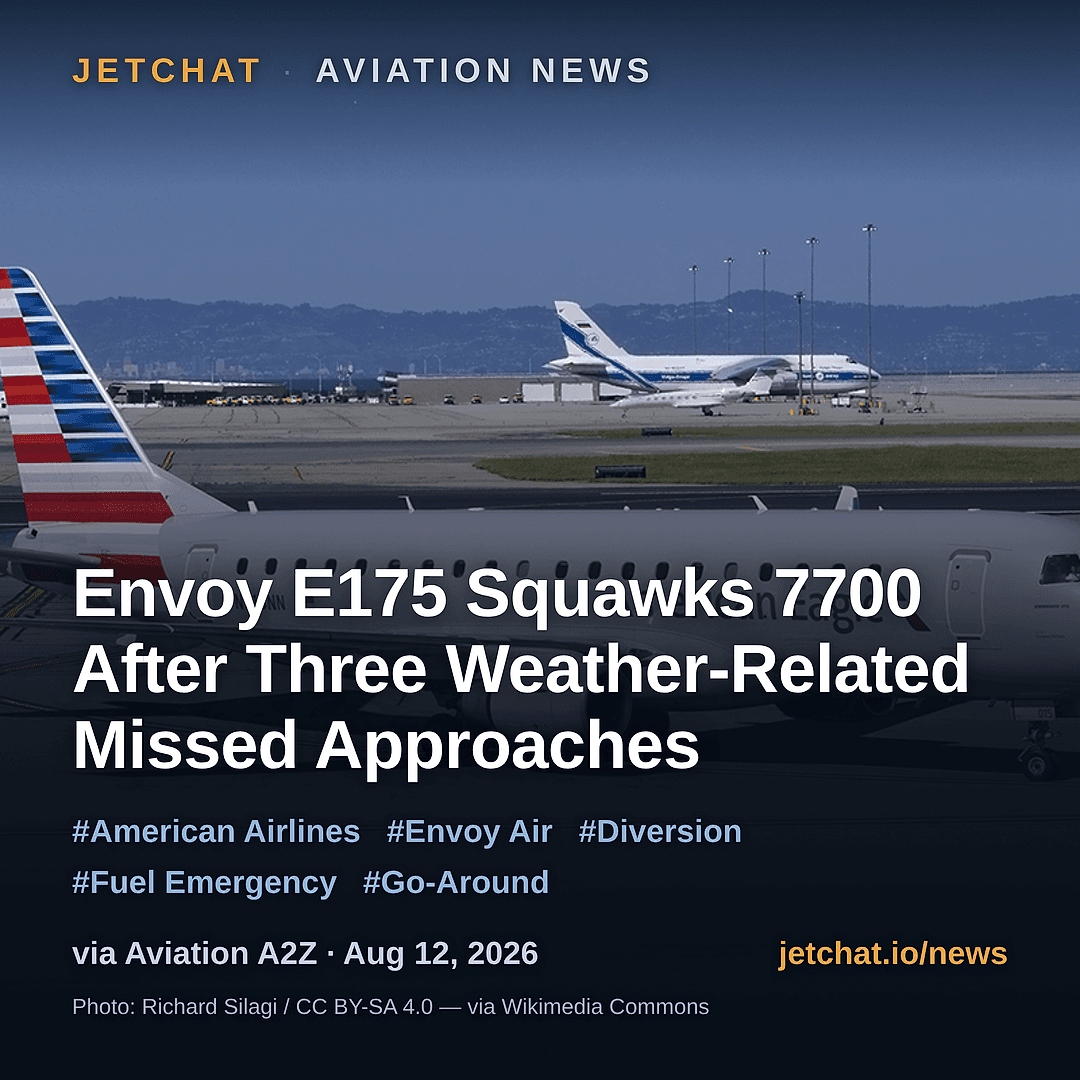
Photo: Richard Silagi / CC BY-SA 4.0 — via Wikimedia Commons (CC BY-SA 4.0) · source
An Envoy Air Embraer E175 flying from Dallas to Lexington diverted to Evansville, Indiana, on August 11 after severe thunderstorms forced the crew to abandon three separate approaches. The pilots executed one go-around at their destination and two more at their Louisville alternate before dipping into their final thirty minutes of fuel and declaring an emergency. For aviators, this incident underscores the critical importance of continuous inflight fuel management and decisive alternate planning when regional storm systems unexpectedly close multiple viable airports.
Read the full take
Under Part 121 operations, airline dispatchers meticulously calculate required fuel, factoring in the trip, legally mandated reserves, and anticipated weather deviations. However, Mother Nature rarely adheres to a printed release. The August 11 ordeal of Envoy Air Flight 3927 perfectly illustrates how rapidly a routine two-hour hop can degrade into a high-workload fuel emergency when widespread convective activity blocks multiple outs. Operating an Embraer E175, the crew initially opted to bail out of their Lexington destination at roughly 2,200 feet as a severe thunderstorm cell parked over the field. Their selected alternate, Louisville, seemed like a logical retreat. Yet, summer squall lines are notoriously dynamic. By the time the regional jet arrived in Louisville airspace, conditions had cratered. The flight crew attempted two separate approaches to parallel runways—descending below 600 feet on the first and 1,500 feet on the second—before torrential rain and vanishing visibility forced them to execute go-arounds both times. Every missed approach in a swept-wing jet requires a high-thrust climb out and radar vectoring, which devours fuel reserves far faster than straight-and-level cruising. Pushing past two hours and forty minutes of flight time, the E175 reached its critical bingo fuel state with only an estimated half-hour of burn remaining. Declaring an emergency and squawking 7700 was the absolute correct procedural move. It immediately stripped away ATC delays, granting the Envoy crew priority routing to a safe touchdown in Evansville. For aspiring airline pilots and current CFIs teaching cross-country planning, this event highlights that declaring a fuel emergency isn't a sign of failure—it is a vital operational tool for utilizing ATC resources when safety buffers vanish. The system worked exactly as designed, transforming a highly stressful weather entrapment into a safe landing.