FAA Investigates Identical American Airlines Callsigns in Phoenix Airspace
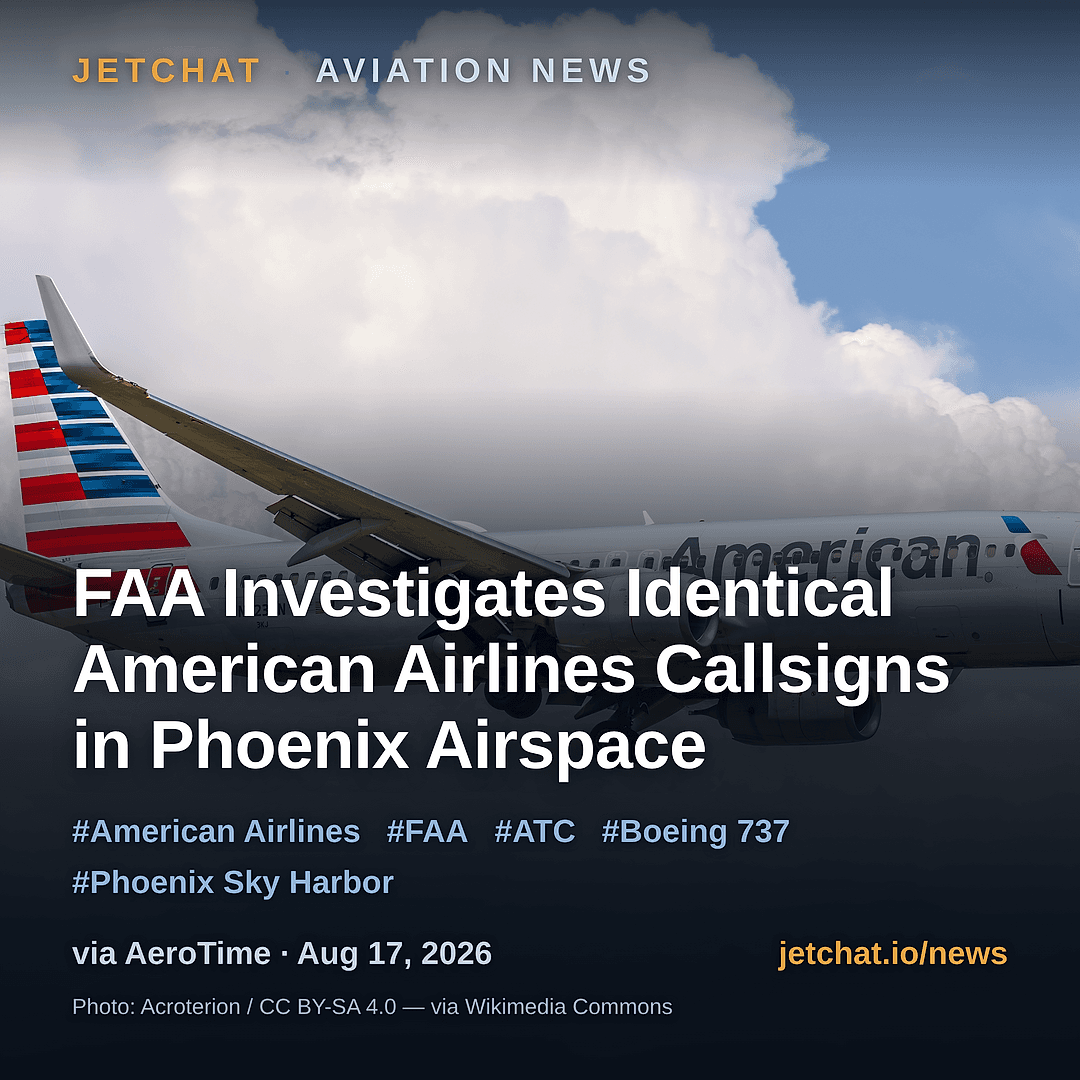
Photo: Acroterion / CC BY-SA 4.0 — via Wikimedia Commons (CC BY-SA 4.0) · source
The FAA is investigating an August 14 incident where two American Airlines Boeing 737s operated simultaneously on the same frequency near Phoenix under the identical callsign American 2482. One aircraft was arriving from Chicago while a substitute aircraft departed for the return leg, creating a hazardous overlap when neither flight plan was modified. Air traffic control recognized the error and restricted altitudes to safely separate the converging jets, underscoring the critical importance of active radio listening and callsign verification for professional pilots.
Read the full take
The aviation system relies heavily on unique identifiers to maintain situational awareness, making duplicate callsigns a chilling scenario for any pilot or controller. This recent event over Phoenix Sky Harbor highlights a gap in how airlines manage delayed turnarounds. Typically, a single airframe flies an out-and-back route using the same flight number for both legs. When weather delayed the inbound Chicago flight, American Airlines swapped in a fresh Boeing 737 to operate the outbound segment on time. However, dispatch failed to append a modifying letter or file a secondary flight number for the outbound jet, resulting in two distinct aircraft sharing a single identity on the exact same radio frequency. Fortunately, the local sector controller caught the discrepancy as the two targets converged. By rapidly adapting phraseology, instructing one crew as the arrival and the other as the departure, ATC successfully kept the climbing aircraft at nine thousand feet while the inbound jet remained above at eleven thousand feet. Both crews ultimately reported having the other in sight, preventing what the veteran controller bluntly noted could have been a disaster. For the broader aviation community, this incident reignites the debate over alphanumeric callsigns. While European operators heavily utilize alphanumeric identifiers to drastically reduce callsign confusion, domestic carriers have historically resisted systematic adoption, favoring traditional passenger flight numbers. As the Federal Aviation Administration adds this case to a growing list of airspace conflicts under review, professional aviators must remain exceptionally vigilant. Acknowledging clearances with full callsigns and actively questioning any controller instruction that seems contradictory or intended for another aircraft remains the ultimate last line of defense.