FAA to Release Updated Unleaded Avgas Transition Roadmap
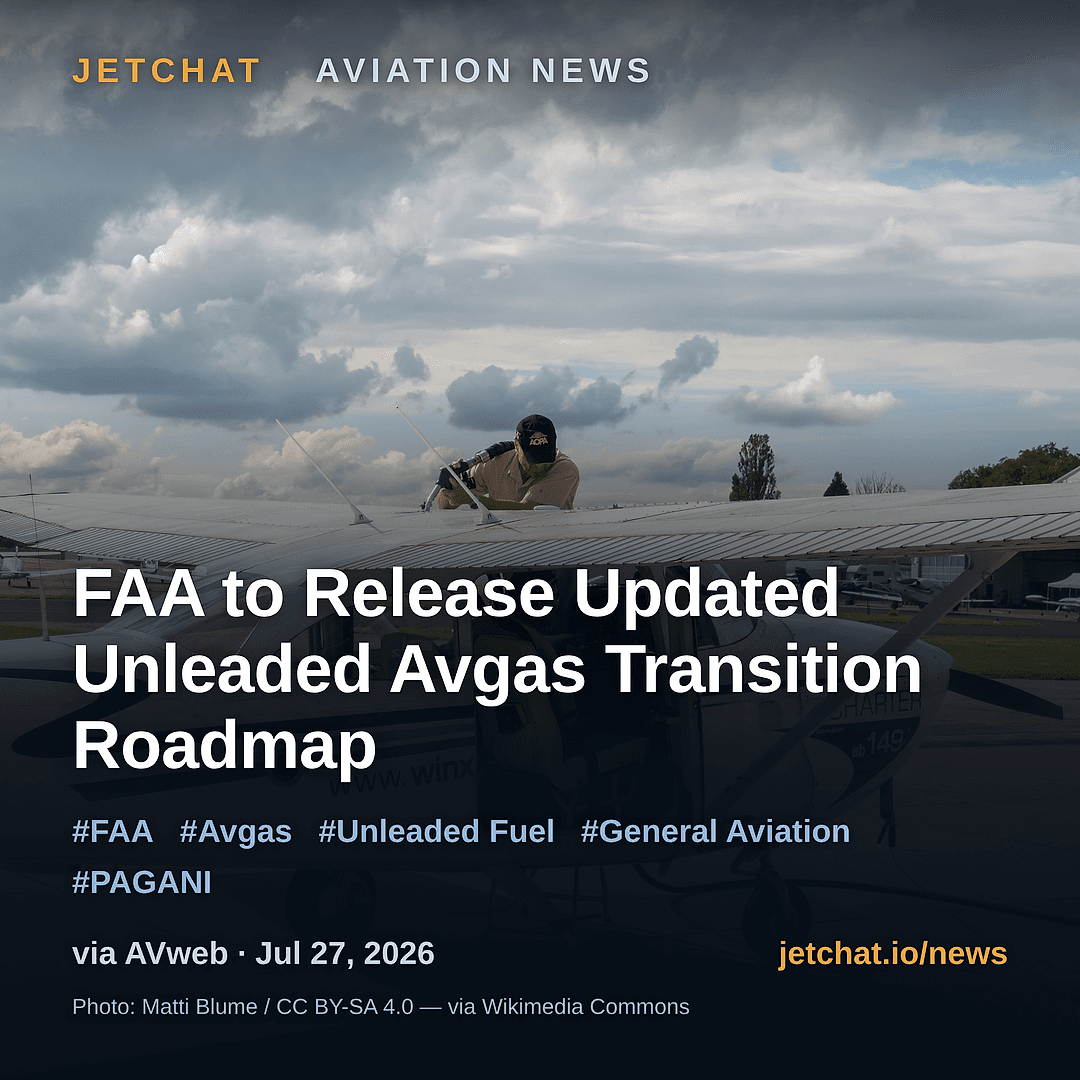
Photo: Matti Blume / CC BY-SA 4.0 — via Wikimedia Commons (CC BY-SA 4.0) · source
The FAA intends to release an updated transition timeline for phasing out 100LL in favor of unleaded aviation fuel. While the national target for eliminating lead emissions remains set for 2030, agency officials emphasized at AirVenture that safety will dictate the schedule rather than arbitrary deadlines. Federal mandates currently prohibit most obligated airports from banning 100LL sales until a certified replacement is locally available. For flight schools and aircraft owners, this upcoming reset clarifies exactly how and when they will need to adapt their operations for the new fuel landscape.
Read the full take
The journey toward a lead-free future for general aviation has been complex, and this forthcoming roadmap adjustment highlights the cautious approach regulators are taking toward a massive infrastructure shift. Although Congress formalized the 2030 deadline in the recent FAA Reauthorization Act, the logistics of replacing 100LL across the entire piston fleet remain daunting. Currently, the market features a mix of fuel candidates progressing through different regulatory pathways. GAMI has secured broad supplemental type certificates for a wide array of engines, while Swift Fuels continues to rapidly expand approvals for its 100R variant. Meanwhile, federal testing programs are actively evaluating other options from producers like LyondellBasell and VP Racing. However, achieving aircraft certification is only the first hurdle in this transition. The actual bottleneck lies in scaling up production, refining distribution networks, and upgrading airport infrastructure to handle new products. Airports will likely require dedicated storage tanks and specialized dispensing trucks. Furthermore, the industry must rigorously test how these new fuels interact with legacy aircraft seals, existing maintenance procedures, and the inevitable commingling of different fuel types in the same tanks. For student pilots, CFIs, and aircraft operators, the revised roadmap will serve as a critical gauge of regulatory reality versus legislative ambition. It signals that while the 2030 goal remains on paper, authorities recognize that forcing a premature switch could ground fleets if the supply chain and safety validations are not fully mature. The aviation community will be watching closely in the coming weeks to see exactly how the agency plans to align these moving parts without disrupting daily flight training and general aviation operations.