Supreme Court to Review Aircraft Forfeiture Over Passenger Alcohol
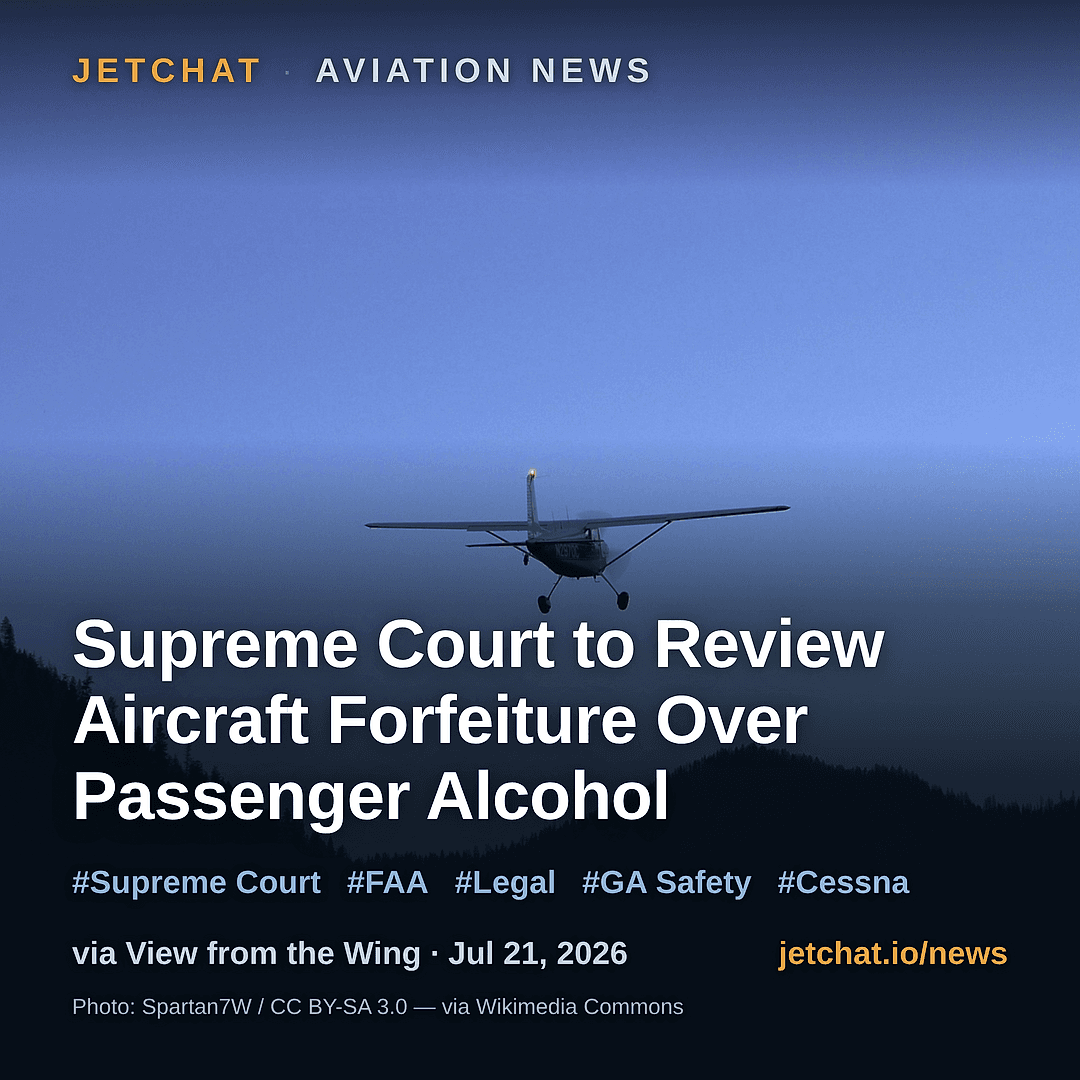
Photo: Spartan7W / CC BY-SA 3.0 — via Wikimedia Commons (CC BY-SA 3.0) · source
The United States Supreme Court has agreed to review a case involving an Alaskan aviator whose expensive Cessna was seized by authorities. The civil asset forfeiture occurred because a passenger attempted to transport alcoholic beverages into a region where alcohol is legally prohibited. Previously, the state supreme court ruled that the government could confiscate the aircraft even if the pilot was only aware of a single visible six-pack among the cargo. This case holds significant weight for pilots regarding their legal liability and property rights concerning passenger luggage.
Read the full take
The impending Supreme Court review of this civil asset forfeiture case strikes at the heart of operational liability for general aviation pilots and charter operators. In Alaska and other remote regions, aircraft serve as the primary lifeline for transporting goods and passengers between isolated communities. Consequently, aviators frequently carry passengers with diverse cargo, making it practically challenging to inspect every item brought aboard. The core legal dispute centers on whether a pilot can permanently lose a high-value asset, such as a ninety-five thousand dollar Cessna, due to the illicit actions of a passenger. While the state court affirmed the seizure based on the pilot's awareness of a minor amount of contraband, the appeal to the federal level challenges the proportionality and constitutional bounds of such government actions. For flight instructors, commercial operators, and private pilots alike, the outcome could redefine the boundaries of responsibility regarding passenger belongings. If the nation's highest court upholds the forfeiture, aviators might need to implement invasive and legally complex search procedures before allowing individuals to board their aircraft, fundamentally altering how backcountry and charter flying operate. Conversely, a ruling in favor of the pilot could establish robust protections for aircraft owners against disproportionate penalties linked to third-party infractions. As the judicial process unfolds, the aviation community will be watching closely to see how the justices balance state enforcement interests against the property rights of aircraft commanders.