Two aging British Airways 777s abort consecutive transatlantic flights
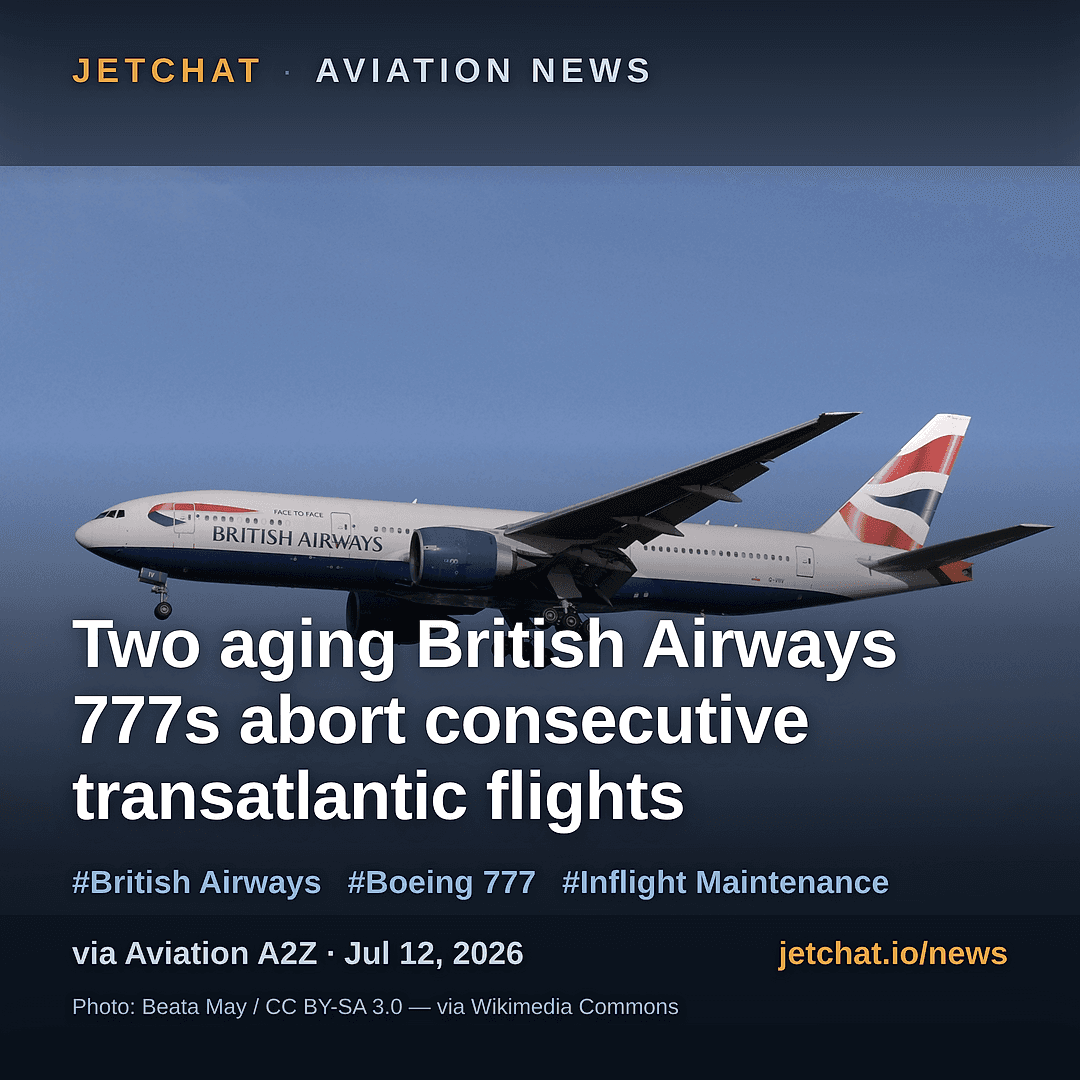
Photo: Beata May / CC BY-SA 3.0 — via Wikimedia Commons (CC BY-SA 3.0) · source
British Airways experienced consecutive operational disruptions when two older Boeing 777-200ERs had to abandon westbound transatlantic crossings and return to London Heathrow. The separate incidents occurred exactly one day apart, with flight crews citing unspecified technical problems over the ocean before safely recovering the widebodies to the airport. No passengers or crew were injured, but the back-to-back cancellations highlight the growing challenges of maintaining legacy airframes, a reality that emphasizes the importance of conservative aeronautical decision-making and strict adherence to checklist discipline for line pilots.
Read the full take
The twin turnbacks of these venerable Boeing 777-200ERs underscore a broader industry squeeze: airlines are being forced to extract maximum utility out of legacy fleets while waiting on delayed next-generation aircraft. The two jets involved in these aborted crossings—clocking in at roughly 26 and 29 years old—are among the oldest operational widebodies in British Airways' inventory. While chronological age alone does not compromise safety when maintenance protocols remain rigorous, older airframes naturally experience higher rates of dispatch interruptions and in-flight mechanical anomalies. For aspiring and current airline pilots, these incidents serve as excellent case studies in operational risk management. The crew of the Baltimore-bound flight, already an hour into their crossing and heavy with oceanic fuel, had to execute a textbook fuel dump to get below maximum landing weight before shooting their approach back into Heathrow. The following day, the crew of the New York-bound jet arrested their climb in the mid-twenties to run diagnostic checklists before making the prudent call to turn around. In both scenarios, the aviators prioritized safety margins over schedule pressure, demonstrating the gold standard of crew resource management. Looking ahead, dispatch reliability for the aging 777-200ER fleet will be a critical metric to watch. British Airways operates more than forty of these variants. While they feature completely modernized passenger cabins, the underlying machinery is nearing its third decade of continuous service. The carrier holds extensive orders for Airbus A350-1000s, Boeing 787s, and Boeing 777-9s to eventually retire these veteran jets. However, with the 777-9 program facing persistent certification and production delays, flight crews and line mechanics will have to keep these legacy workhorses safely crossing the Atlantic for several more years.