Union Warns of Spontaneous Engine Shutdowns on Airbus Aircraft
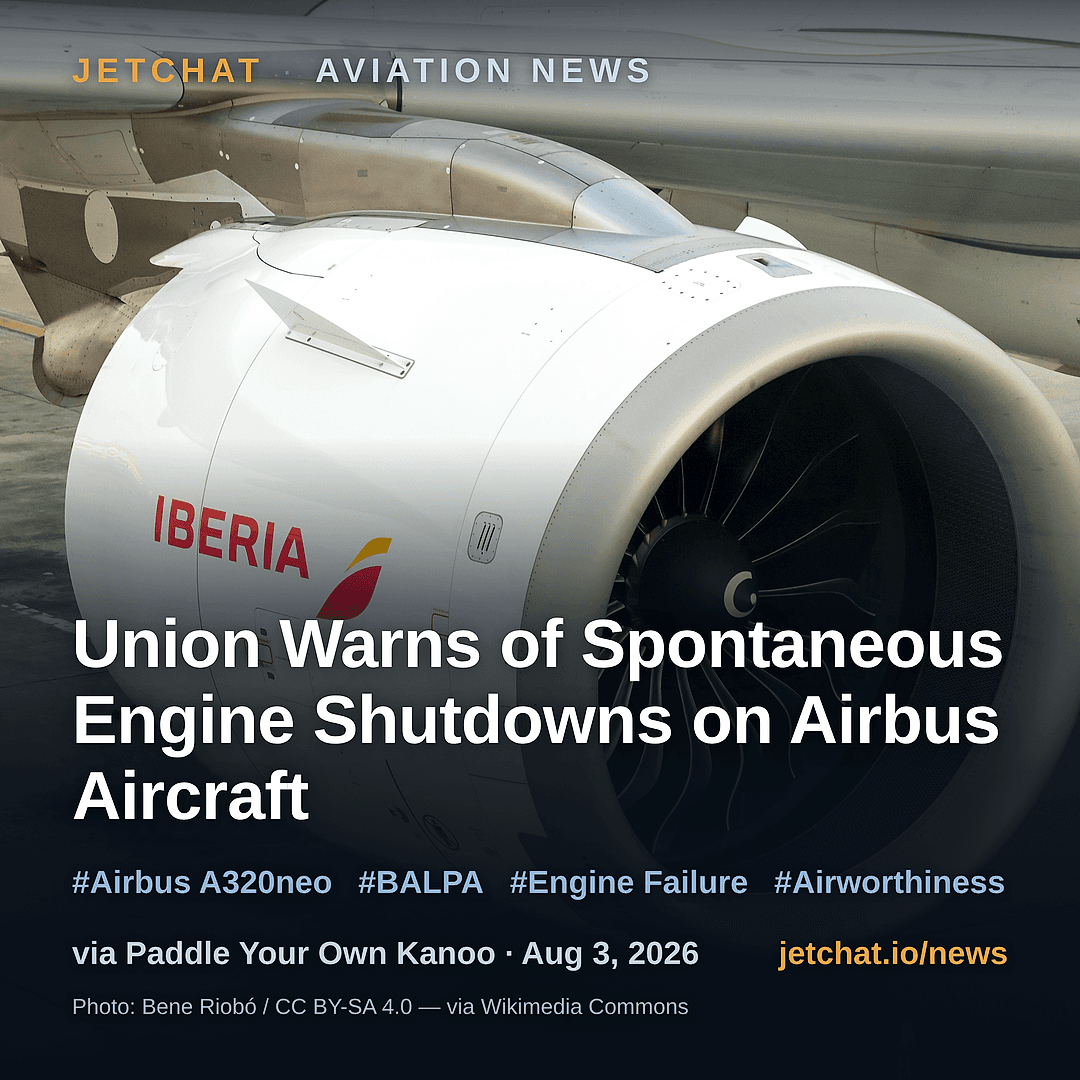
Photo: Bene Riobó / CC BY-SA 4.0 — via Wikimedia Commons (CC BY-SA 4.0) · source
The British pilots union BALPA is sounding the alarm over a mechanical defect that can cause Airbus engine fire pushbuttons to activate independently, leading to uncommanded in-flight engine shutdowns. The issue stems from bent retaining pins inside the switch modules that can dislodge due to standard flight vibrations. While European regulators mandate inspections for the A320 family by late 2027, the union recently highlighted a similar engine-loss event on a British Airways A350. For line pilots, diagnosing this latent failure requires sharp situational awareness because initial monitoring system alerts can be ambiguous.
Read the full take
An uncommanded engine shutdown is a critical emergency under any circumstance, but the mechanism behind this Airbus fire switch defect makes it particularly insidious for flight crews. When the engine fire pushbutton is depressed or in this case pops out on its own it mechanically isolates the powerplant. It instantly severs the fuel supply, cuts electrical generation, and closes bleed air valves. The root cause traces back to a fragile retaining pin inside the button module that can bend if roughly handled during maintenance installations. Over time, routine harmonic vibrations in the flight deck cause the damaged pin to slip, releasing the button without any human input. What makes this scenario incredibly challenging on the flight deck is the lack of immediate, clear diagnostic data. Electronic Centralised Aircraft Monitor systems are designed to prompt crews based on sensed faults, but a self-activating fire switch presents as a sudden, cascading loss of engine parameters rather than a specific switch failure. During a recent event involving an A350 over North America, the flight crew received only brief, ambiguous monitor messages before discovering the right engine had spooled down. European regulators have responded with an airworthiness directive for the A320 family, mandating that operators inspect these modules and replace any damaged units by late 2027. However, union representatives argue this compliance window is far too generous for a single-point failure that leaves no digital warning trace. Furthermore, the directive currently omits widebody airframes like the A350, despite sharing similar switchgear. Until the global fleet is fully inspected, Airbus operators must rely heavily on systems knowledge and manual troubleshooting, watching for subtle physical cues like a distinct clicking sound from the overhead panel that might signal an imminent engine loss.