Virgin 737 Aborts Takeoff at Sydney After Qantas Incursion
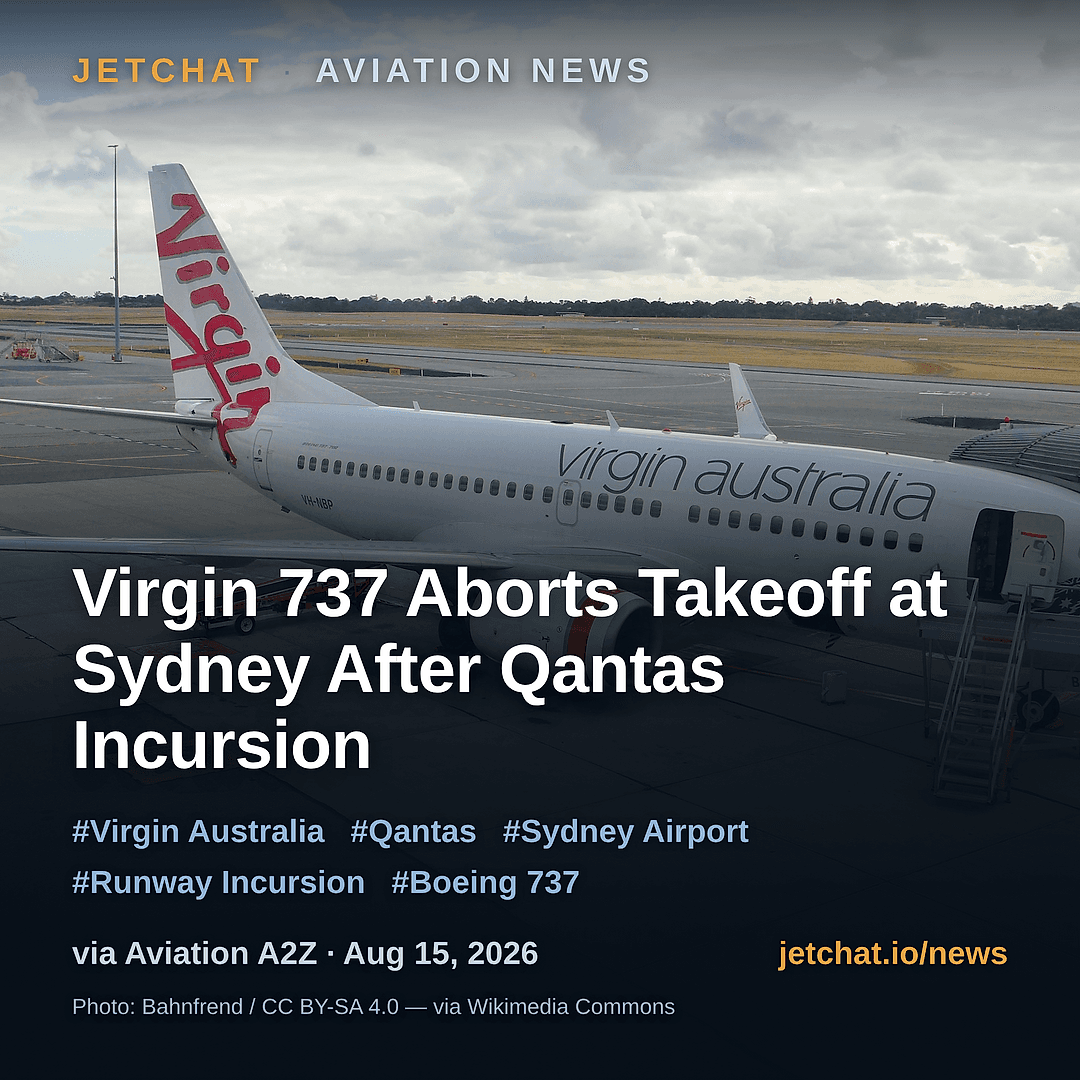
Photo: Bahnfrend / CC BY-SA 4.0 — via Wikimedia Commons (CC BY-SA 4.0) · source
The Australian Transport Safety Bureau is investigating an August runway incursion at Sydney Airport where a Virgin Australia Boeing 737 had to reject its takeoff after a Qantas 737 crossed the active runway. Air traffic controllers reportedly issued conflicting clearances to both aircraft before canceling the Virgin jet's takeoff roll. The incident highlights ongoing concerns over controller staffing levels and ground safety at the airport. This matters to pilots because it underscores the crucial need for constant situational awareness and runway scanning, even when cleared for departure.
Read the full take
The recent runway incursion at Sydney Airport involving two Boeing 737s serves as a stark reminder of how quickly ground operations can deteriorate, even at highly controlled international hubs. On August 9, a Virgin Australia crew initiated their takeoff roll on Runway 34L only to have air traffic control abruptly cancel their clearance. Downfield, a Qantas 737 had been cleared to cross the same runway at an intersection. While a disaster was averted by a reported distance of over a kilometer, the systemic issues at play demand industry attention. A major point of contention in the aftermath has been the initial reporting threshold. The air navigation service provider initially defended not classifying the event as a mandatory report, arguing the aircraft remained sufficiently separated and the Virgin jet was barely moving when the clearance was revoked. However, safety investigators have formally stepped in, treating the event as a serious runway incursion and rejected takeoff. For flight crews, this incident is a textbook example of why the sterile cockpit rule and vigilant outside scanning are non-negotiable during ground operations. Trusting an ATC clearance is fundamental to the aviation system, but controllers are human and subject to high workload errors. The fact that this is the third serious ground safety event at Sydney Airport in a matter of weeks points toward potential systemic stressors, with aviation stakeholders pointing to chronic air traffic controller staffing shortages and fatigue. As investigators gather data, cockpit voice recordings, and tower communications, the broader pilot community should watch for findings related to clearance phraseology, intersection management, and airport surface detection equipment. In the meantime, the takeaway for every aviator from student to airline captain is clear: always visually verify that the departure path is clear, regardless of what the radio says.