FAA Updates Certification Guidance for Cockpit Touchscreens and Voice Commands
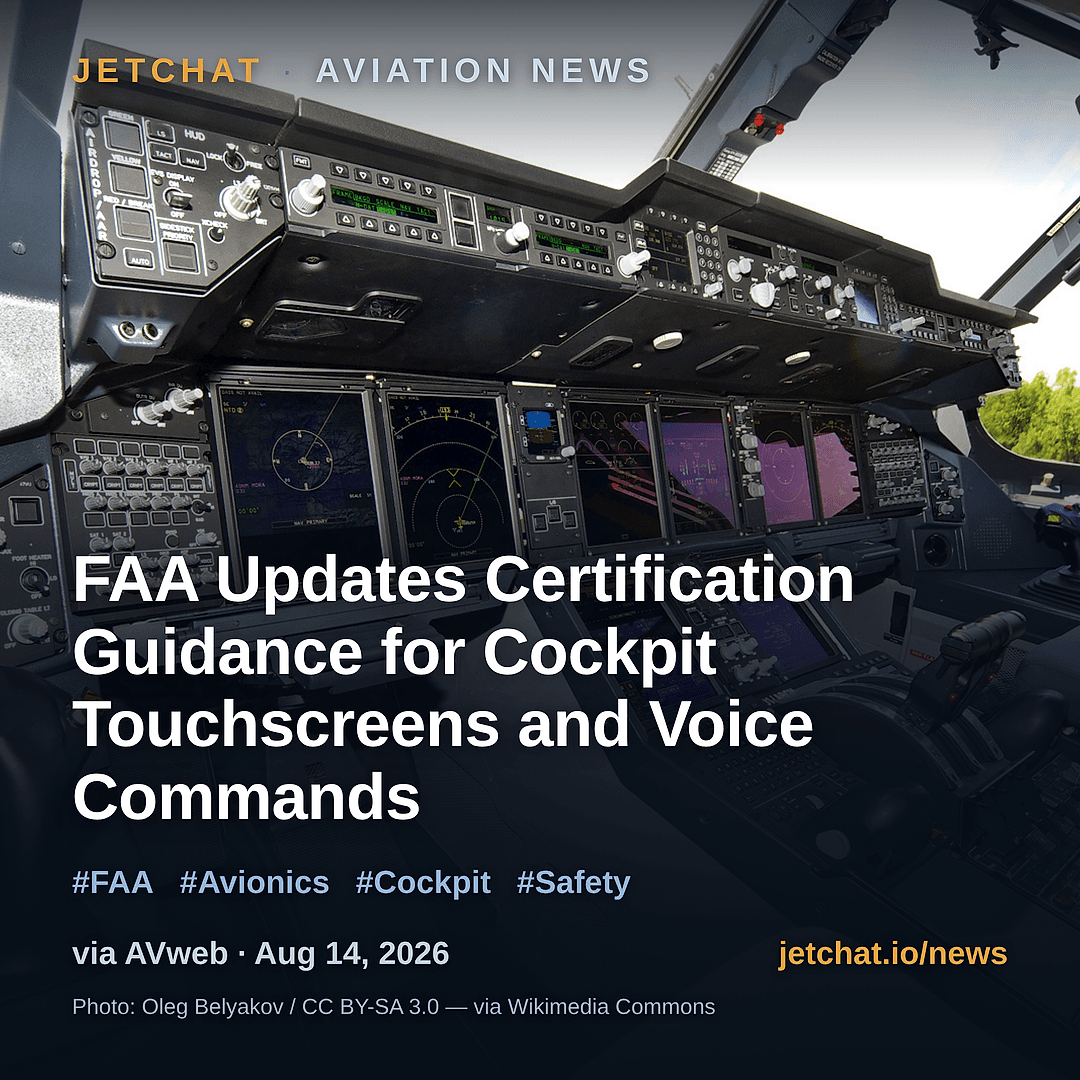
Photo: Oleg Belyakov / CC BY-SA 3.0 — via Wikimedia Commons (CC BY-SA 3.0) · source
The Federal Aviation Administration is seeking public comments through late September on updated certification guidelines for modern cockpit interfaces, including touchscreens and speech recognition. The proposed draft replaces a decade-old document, introducing strict standards for voice command success rates, manual control overrides, and touchscreen usability during turbulence. For pilots navigating increasingly digital flight decks, these proposed standards ensure that critical avionics remain reliably accessible when workload increases and that everyday cockpit hazards will not disable primary flight displays.
Read the full take
As flight decks rapidly evolve from physical buttons to glass panels and voice-activated systems, regulators are working to ensure safety keeps pace with technology. The newly proposed Advisory Circular essentially modernizes the certification roadmap for avionics manufacturers, addressing the practical realities of flying complex aircraft. A major focus is on speech recognition. While talking to an airplane can reduce a pilot's head-down time, the agency recognizes that a noisy cockpit environment, pilot fatigue, and diverse vocal accents can severely degrade performance. Under the new draft, avionics developers must measure the actual command success rate rather than basic word recognition. Furthermore, voice controls can never be the sole method of operation; pilots must always have an immediate manual override. Touchscreen guidelines are equally pragmatic. The agency wants manufacturers to design interfaces that work when the aircraft is bouncing through rough air. This means incorporating physical bezels or grips for hand stabilization and avoiding complex multi-finger swipes that are nearly impossible to execute accurately in turbulence. The draft also mandates that essential functions cannot be buried under multiple digital menus and requires displays to survive everyday cockpit hazards like sunlight glare, scratches, and spilled beverages. While these standards will not force operators to retrofit existing panels, they signal a clear shift in how future glass cockpits and emerging advanced air mobility platforms will be designed. Pilots and flight instructors can expect the next generation of avionics to feature highly refined, multimodal interfaces that prioritize immediate accessibility and redundant manual controls when automation falters.