JetChat Newsjetchat.io ↗

Topic

#NTSB

← All briefs
safety

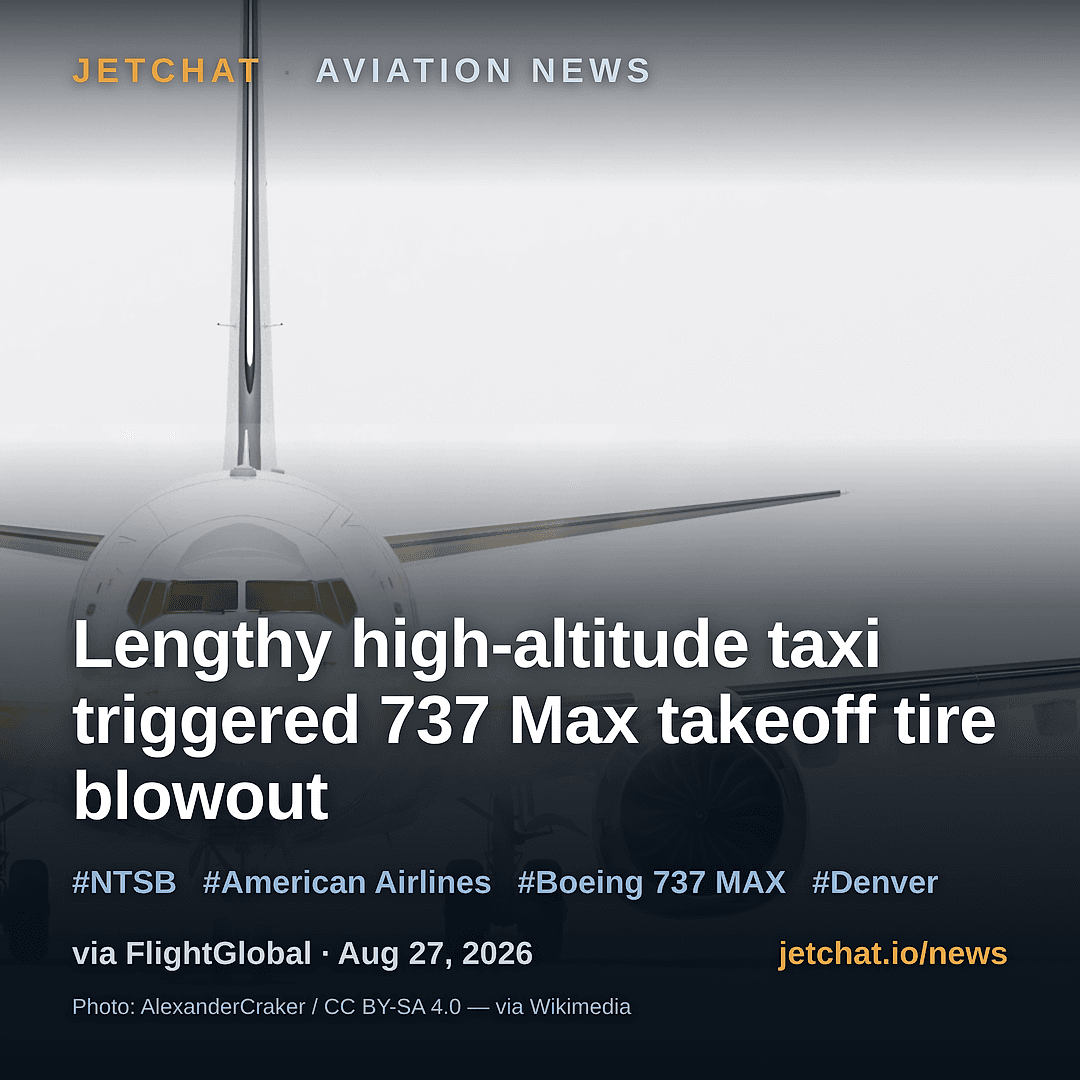
Lengthy high-altitude taxi triggered 737 Max takeoff tire blowout

An American Airlines Boeing 737 Max 8 suffered a dual tire blowout during its takeoff roll in Denver last July after a six-nautical-mile taxi on a hot summer day. The National Transportation Safety Board determined that the extended taxi time, combined with high ambient temperatures, a heavy aircraft, and multiple runway changes due to shifting winds, caused the main gear thermal relief plugs to melt. The subsequent high-speed abort and evacuation underscore the real-world impact of brake energy accumulation during prolonged ground operations.


safety

NTSB: Marine One Comm Failure Preceded Airliner Close Call

The National Transportation Safety Board reports that a Sikorsky VH-3D Sea King operating as Marine One experienced a near-miss with a commercial airliner after departing without establishing communication with air traffic control. Radio issues prevented the military flight crew from checking in with controllers prior to takeoff while transporting the president earlier this month. This incident serves as a stark reminder for all aviators about the critical dangers of operating in congested airspace during a loss of communication.

safety

NTSB attributes CRJ700 dual wing strike to poor crosswind correction.

The National Transportation Safety Board determined that inadequate crosswind inputs caused an Endeavor Air CRJ700 to strike both wingtips during a landing attempt at Atlanta. Encountering a sudden gust during the flare, the aircraft ballooned and rolled left, scraping the runway before the captain overcorrected during the go-around and drove the right wing into the pavement. For pilots transitioning to regional jets, this event underscores the necessity of flying the airplane through the entire flare, especially in airframes with tight ground clearances.

safety

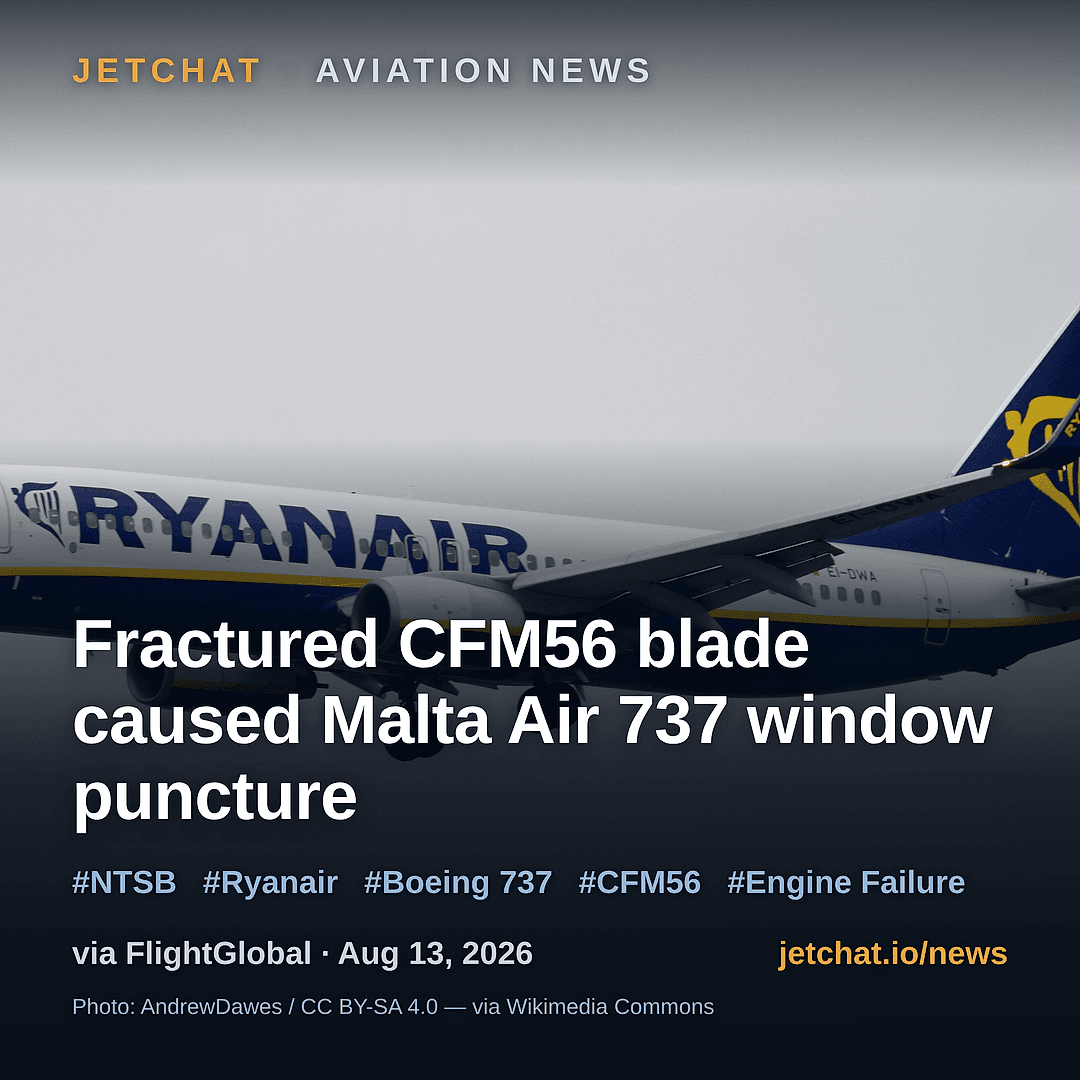
Fractured CFM56 blade caused Malta Air 737 window puncture

US investigators found that a broken CFM56 fan blade punctured the engine inlet cowl of a Malta Air Boeing 737-800 during a July flight, causing debris to shatter a passenger window and trigger a rapid depressurization. The blade snapped at its root due to suspected metal fatigue, though inspectors also discovered bird remains inside the powerplant. This incident matters to airline crews because it highlights how forward-thrown engine debris can bypass fan-case containment shielding and threaten fuselage integrity, even after routine ultrasonic blade inspections.

safety

American Airlines and Feds Reach Secret DCA Midair Settlement

American Airlines and federal officials have finalized an undisclosed financial settlement to apportion liability costs stemming from a deadly midair collision near Washington National Airport. The crash, which claimed 67 lives, was previously attributed by the National Transportation Safety Board to errors by an Army helicopter crew and air traffic control, clearing the airline's flight crew of fault. The sealed agreement resolves pending financial disputes over passenger and crew lawsuits, highlighting how complex liability disputes are resolved behind closed doors long after the NTSB concludes its safety investigation.

safety

UPS MD-11 engine separation highlights single point of failure

On November 4, 2025, a UPS McDonnell Douglas MD-11 freighter experienced a catastrophic engine separation while operating at Louisville Muhammad Ali International Airport. The incident occurred during a normal taxi and takeoff roll on Runway 17R, resulting in the powerplant physically detaching from the aircraft wing. Investigators are treating the event as a stark reminder of the dangers associated with single points of failure in legacy transport category aircraft. For pilots, this underscores the importance of rigorous preflight inspections and remaining vigilant for abnormal engine indications during takeoff.

safety

NTSB probes fatal King Air crash amid GPS jamming

The National Transportation Safety Board is investigating a fatal Beechcraft C90 King Air medical flight that struck mountainous terrain during a night visual approach in New Mexico. The accident occurred while active military GPS jamming was affecting the region, forcing the crew to abandon an area navigation approach before eventually opting to fly visually in total darkness. Investigators are still determining if degraded satellite navigation played a direct role in the tragedy, highlighting the critical risks of relying on visual references over hazardous terrain during widespread GPS outages.

safety

Fatal Medevac Crash Follows Military GPS Jamming During Approach

A medical evacuation flight crashed into mountainous terrain shortly after losing GPS navigation capabilities due to military testing. Air traffic control temporarily paused the signal interference to assist the crew but subsequently allowed the jamming to resume while the aircraft executed a visual approach on a dark, moonless night. Four people perished when the aircraft struck a 10,000-foot ridge just minutes later. This tragic accident underscores the severe hazards of relying solely on satellite navigation during military signal disruptions and highlights the critical need for spatial awareness during night visual operations.

safety

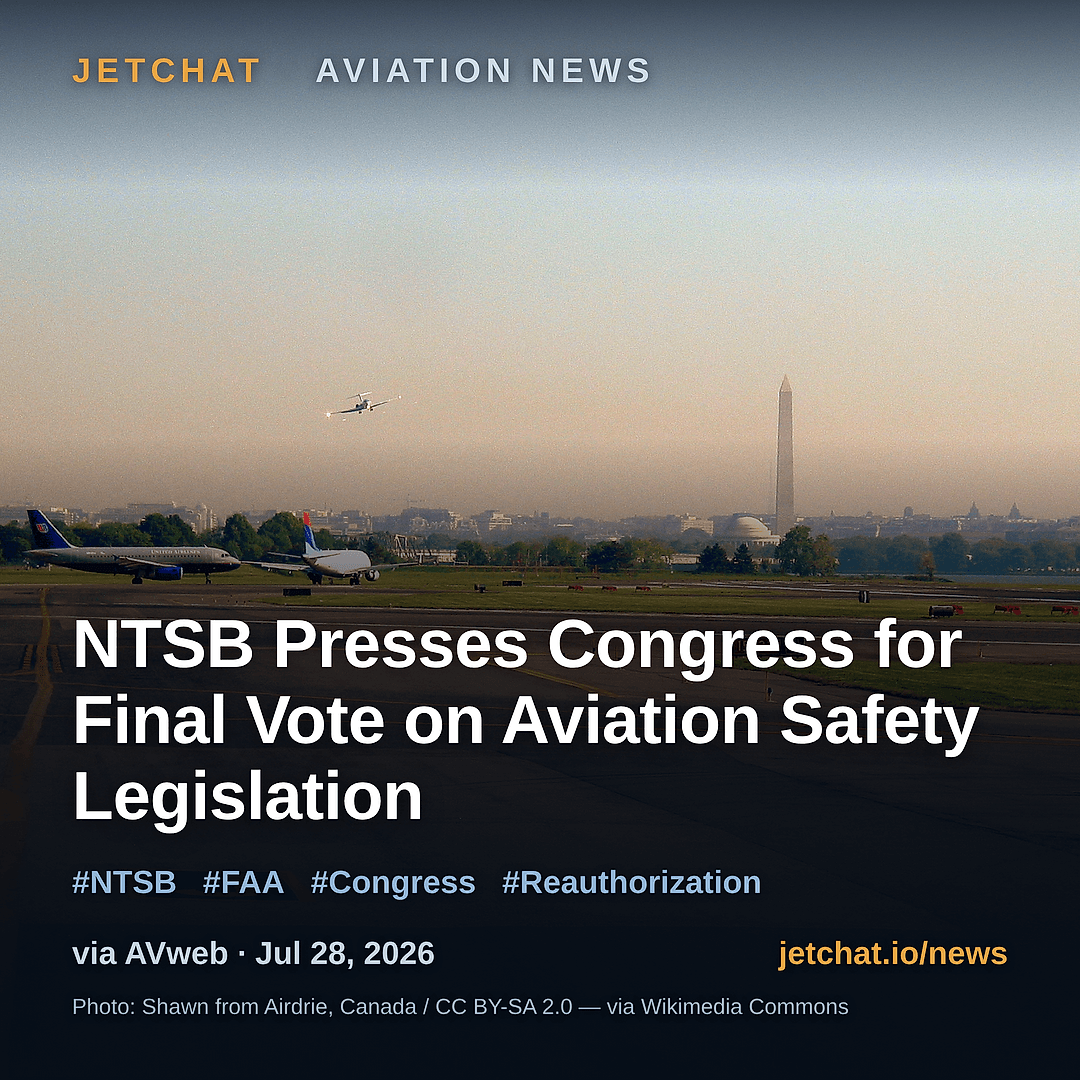
NTSB Presses Congress for Final Vote on Aviation Safety Legislation

The National Transportation Safety Board is urging lawmakers to finalize safety legislation following the fatal January 2025 midair collision near Ronald Reagan Washington National Airport. The House and Senate previously passed independent bills addressing the tragedy, but Congress adjourned for its August recess without merging the measures into a unified law. Investigators want immediate action in September to enact all fifty safety recommendations, including a proposed mandate for ADS-B In equipment. For pilots, mandated cockpit traffic displays could soon become a requirement in tightly controlled airspace.

safety

Fatal Kitfox Crash Highlights Crosswind Tailwheel Takeoff Risks

The NTSB determined that a fatal July 2024 Kitfox crash in Pennsylvania resulted from the pilot losing directional control during a crosswind takeoff. Departing a narrow forty-foot asphalt runway, the pilot raised the tailwheel, prompting an immediate hard left turn off the pavement and into a cornfield. While the flying pilot suffered minor injuries, a passenger was killed when the right main landing gear collapsed. This accident serves as a critical reminder for aviators to maintain aggressive rudder inputs and proper aileron deflection during crosswind departures in conventional gear aircraft.

safety

NTSB: Controller Forgot Takeoff Clearance In Boston Runway Incursion

A recently released preliminary report from the National Transportation Safety Board indicates that an air traffic controller at Boston Logan International Airport forgot they had cleared an American Airlines Boeing 737 for takeoff, leading to a close call with an arriving Delta Air Lines Airbus A319. The incident, which occurred late last month, was narrowly avoided thanks to the prompt reaction of the incoming Delta flight crew. This serves as a stark reminder for pilots to always maintain high situational awareness and independently verify clearances during surface operations.

safety

Fatal Beech B-60 Crash Blamed on Contamination, Single-Engine Go-Around

A Beech B-60 crashed in Ohio after experiencing a total left engine failure caused by fuel system contamination, killing the pilot and two passengers. According to the NTSB, the pilot attempted to land with gear and flaps fully extended but initiated a single-engine go-around at the runway threshold, resulting in a fatal loss of control. Investigators discovered plastic polymer debris in both engine fuel servos and noted a history of neglected maintenance, emphasizing that rushing an unairworthy aircraft back into service carries deadly consequences.

safety

NTSB Probes Starter Generator in Fatal NetJets Citation Crash

The National Transportation Safety Board is investigating a damaged right-engine starter generator discovered in the wreckage of a NetJets Cessna Citation Latitude that crashed in Texas this June. According to the preliminary report, the flight crew noticed unusual vibrations shortly after departure from Mexico, followed later by cascading fuel pressure and electrical warnings before a dual-engine flameout on final approach to Laredo. The findings underscore the importance of thoroughly diagnosing abnormal in-flight vibrations and the potential for cascading system failures following isolated component damage.

safety

Dual Engine Flameout Preceded Fatal Citation Latitude Highway Crash

The NTSB's preliminary report on a fatal NetJets Cessna Citation Latitude crash in Texas points to a dual engine flameout following cascading mechanical failures. The crew diverted to Laredo after experiencing early vibrations, fuel pressure alerts, and electrical issues, but lost both powerplants on short final, forcing a highway landing that killed one passenger. For pilots, this highlights the critical importance of early diversion decisions when facing abnormal engine vibrations and compounding system warnings.