JetChat Newsjetchat.io ↗

JetChat Aviation News

Short, human-curated aviation briefs for pilots and enthusiasts.

industry

First production Yakovlev MC-21 completes long flight to Moscow

Russia successfully relocated the first production-standard Yakovlev MC-21-310 to Moscow following a nearly six-hour, 2,270-nautical-mile transit from Irkutsk. Equipped with domestically manufactured PD-14 powerplants, the twinjet reached altitudes approaching 40,000 feet without experiencing any system anomalies. Engineers will now conduct additional evaluations and apply the launch customer livery for the Aeroflot Group. This milestone highlights ongoing international efforts to develop entirely indigenous commercial airliners amidst shifting global aerospace markets.


safety

Identical Callsigns Place Two American Jets on Same Frequency

On August 13, a scheduling delay resulted in two American Airlines Boeing 737s operating under the exact same callsign on the same Phoenix air traffic control frequency. Flight 2482 is used for both directions of the carrier's Chicago-Phoenix route, and a delayed inbound flight overlapped with an on-time outbound departure. A veteran controller safely managed the conflict by explicitly distinguishing the aircraft as either arriving or departing. This incident highlights why pilots must maintain strict radio discipline and situational awareness when operating common hub routes.

safety

Report: A320neo Flight Controls Briefly Failed Before Sudden Plunge

An internal manufacturer document reveals that the flight control computers on an Air India A320neo went offline for about four seconds before a sudden 300-foot drop at cruise altitude last August. The brief loss of elevator and aileron authority caused an uncommanded pitch-up, and the first officer's nose-down inputs were delayed by a temporary hydraulic loss, injuring 24 people. For line pilots, this incident underscores the critical importance of understanding fly-by-wire reversion modes during transient system failures.

industry

Heart's 25,000-pound X1 electric demonstrator completes maiden flight

Heart Aerospace successfully flew its X1 battery-electric demonstrator from upstate New York’s Plattsburgh International Airport, marking a major milestone for alternative propulsion. The twenty-seven-minute maiden sortie reached an altitude of 1,100 feet, utilizing a megawatt-class electric powertrain that cost a mere five dollars to charge. At over 25,000 pounds with a 106-foot wingspan, the X1 is now the heaviest battery-electric aircraft to take to the skies. For future airline pilots, this successful test brings the thirty-seat hybrid-electric regional airliner concept one step closer to actual line operations.

industry

FAA faces massive funding shortfall for next-generation ATC platform

The Federal Aviation Administration is actively soliciting proposals to combine its terminal and high-altitude air traffic software into a unified interface, yet remains billions of dollars short of the required budget. Several major defense and aerospace firms, including Thales and Collins Aerospace, are pitching custom cloud-based solutions to secure the lucrative development contract. Lawmakers have yet to allocate the estimated ten billion dollars needed just for the software overhaul. For pilots, this matters because a modernized automation platform could drastically reduce controller workload and minimize systemic routing delays.

airlines

Lufthansa Declines Earliest Production Boeing 777-9 Airframes

The German flag carrier has announced it will not accept some of the initial Boeing 777-9 airframes manufactured during the program's lengthy certification delays. Carrier leadership noted during a recent financial briefing that they are currently negotiating with the American aerospace manufacturer to determine which specific early-build jets will be completely declined and which might be updated to current specifications at Boeing's expense. For aspiring airline pilots, this highlights how aircraft certification hurdles can impact fleet integration timelines and future hiring waves at major international operators.

safety

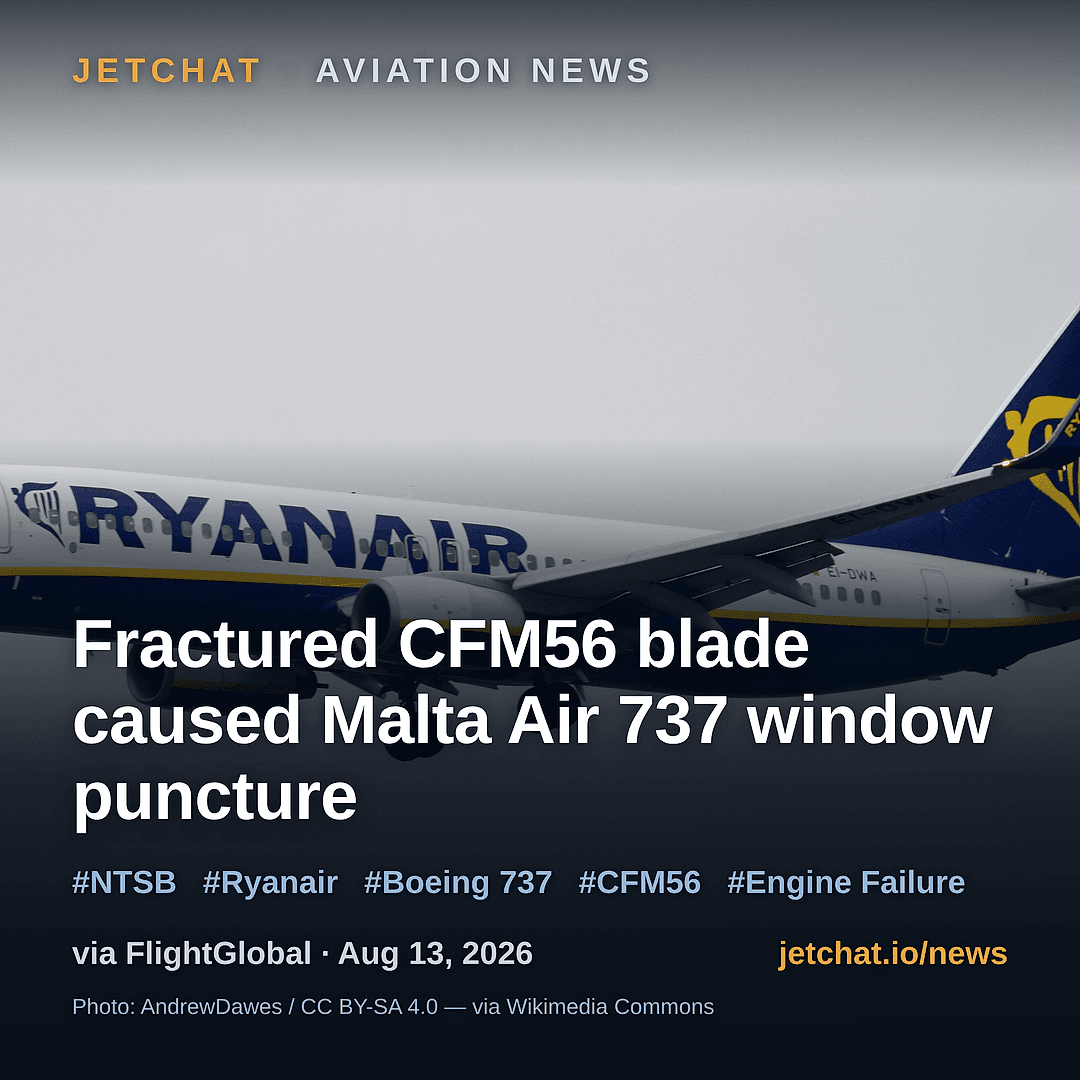
Fractured CFM56 blade caused Malta Air 737 window puncture

US investigators found that a broken CFM56 fan blade punctured the engine inlet cowl of a Malta Air Boeing 737-800 during a July flight, causing debris to shatter a passenger window and trigger a rapid depressurization. The blade snapped at its root due to suspected metal fatigue, though inspectors also discovered bird remains inside the powerplant. This incident matters to airline crews because it highlights how forward-thrown engine debris can bypass fan-case containment shielding and threaten fuselage integrity, even after routine ultrasonic blade inspections.

safety

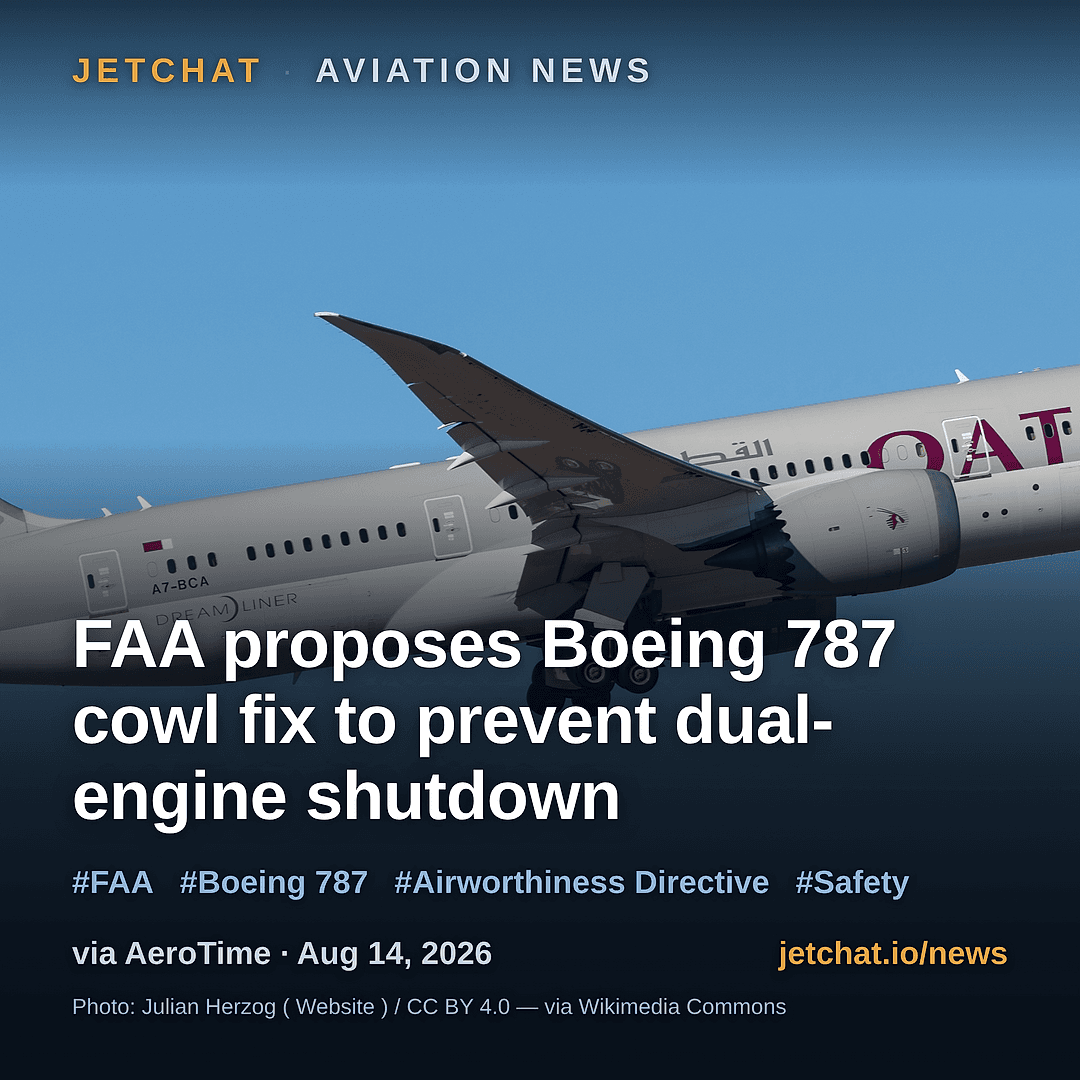
FAA proposes Boeing 787 cowl fix to prevent dual-engine shutdown

The FAA is proposing a new airworthiness directive for Boeing 787 Dreamliners equipped with Rolls-Royce Trent 1000 engines to address a shielding vulnerability. Boeing discovered that an uncontained failure in the left engine could launch debris into the right engine's oil lines, potentially triggering a catastrophic dual-engine shutdown. The rule would mandate inspections and part modifications for 22 affected US-registered aircraft. For pilots, this underscores the vital importance of system redundancy and the intense engineering scrutiny required to maintain safety in twin-engine operations.

safety

American Airlines and Feds Reach Secret DCA Midair Settlement

American Airlines and federal officials have finalized an undisclosed financial settlement to apportion liability costs stemming from a deadly midair collision near Washington National Airport. The crash, which claimed 67 lives, was previously attributed by the National Transportation Safety Board to errors by an Army helicopter crew and air traffic control, clearing the airline's flight crew of fault. The sealed agreement resolves pending financial disputes over passenger and crew lawsuits, highlighting how complex liability disputes are resolved behind closed doors long after the NTSB concludes its safety investigation.

airlines

Delta Faces Class Action Over Unpaid Pilot Military Leave

A federal judge has granted class-action status to Delta Air Lines pilots suing the carrier over unpaid short-term military leave. The lawsuit alleges that Delta compensates aviators for similar short-term absences, such as jury duty or bereavement, but unlawfully withheld pay from National Guard and reserve members. Covering over one hundred thousand leave events since 2007, the case could cost the airline millions. This matters to pilots because it could set a major legal precedent regarding how airlines must treat reserve duty compensation across the industry.

airlines

airBaltic slashes A220 fleet to prioritize long-term financial stability

Latvian flag carrier airBaltic is pivoting from rapid expansion to financial survival, shrinking its all-Airbus A220 fleet from 54 to just 36 aircraft by the end of 2026. The airline will rely on increased aircraft utilization and stronger year-round ACMI partnerships to maintain scheduled capacity while focusing its network around Riga. For aspiring airline pilots, this strategic contraction highlights how geopolitical instability and persistent engine supply chain constraints can rapidly stall pilot hiring and force aggressive corporate restructuring at formerly fast-growing international carriers.

airlines

Korean Air and Asiana shareholders approve December 2026 merger

Korean Air and Asiana Airlines have cleared a major administrative hurdle, securing final board and shareholder approvals to form a single integrated carrier by late 2026. Following conditional clearance from South Korean regulators earlier this summer, both airlines are now focusing on amending their Air Operator Certificates and securing international flight permits. The consolidated airline is scheduled to officially launch on December 17. For commercial aviators, this massive consolidation will likely reshape international hiring, training pipelines, and seniority lists in the Asia-Pacific market.

safety

Shattered Outer Windshield Forces United 787 Diversion to Boston

A United Airlines Boeing 787-8 en route from Washington Dulles to Munich diverted to Boston Logan International Airport on August 10 after the aircraft's outer windshield pane shattered. Flight 108, carrying 175 passengers and 11 crew members, landed safely before its planned transatlantic crossing. The carrier subsequently canceled the leg and rebooked passengers amidst heavy network disruptions caused by regional thunderstorms. For line pilots, this incident underscores the value of multilayered flight deck window designs that maintain structural integrity and pressurization during outer-pane failures.

airlines

American Airlines Reorganizes Executive Ranks to Narrow Profit Gap

American Airlines is restructuring its executive leadership team as the carrier faces mounting pressure to improve its financial performance. The airline's chief executive officer hopes the top-level changes will help the company catch up to the profitability metrics currently enjoyed by industry peers Delta and United. For aspiring airline pilots, this corporate reshuffling signals potential strategic shifts that could eventually influence fleet planning, route expansion, and future pilot hiring initiatives.

industry

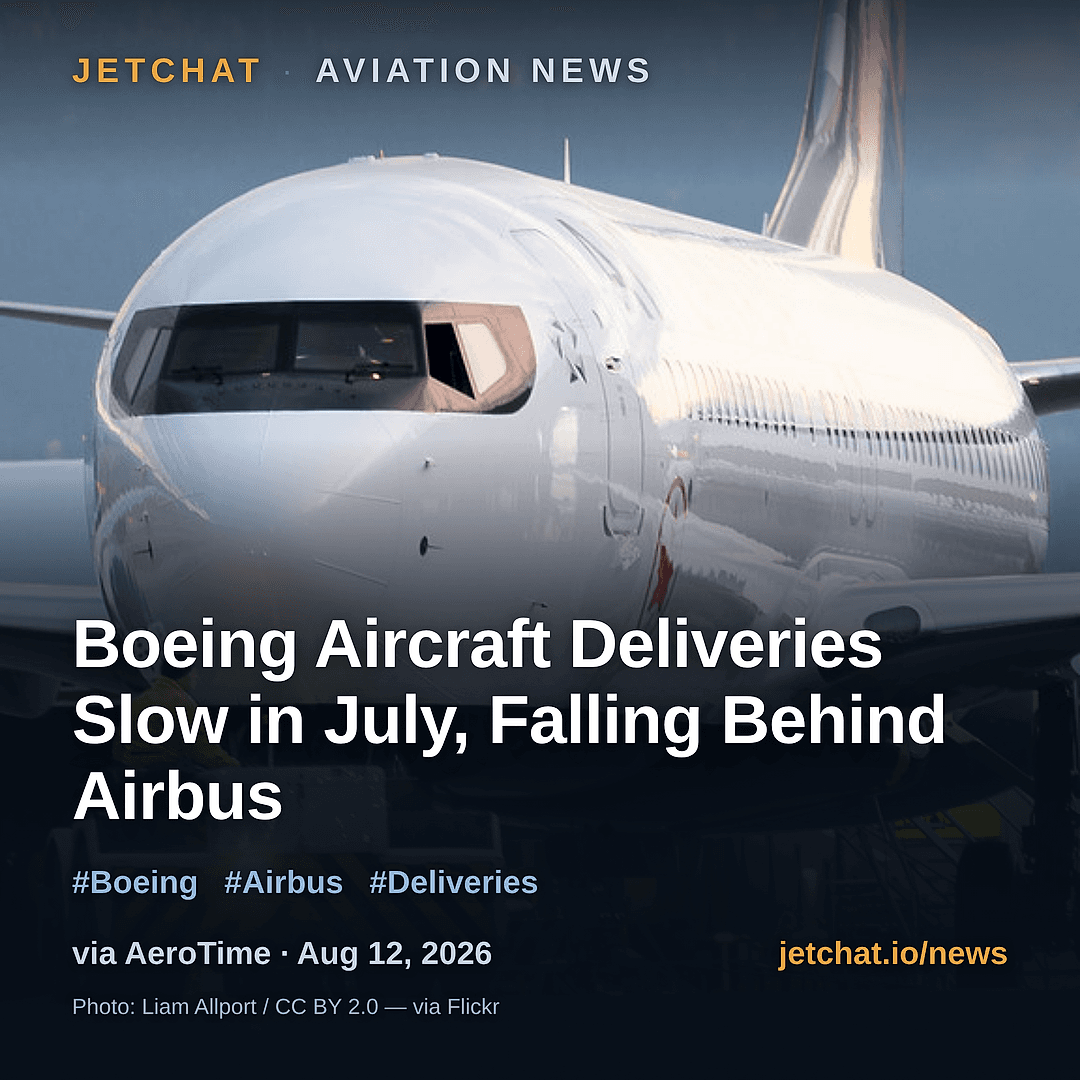
Boeing Aircraft Deliveries Slow in July, Falling Behind Airbus

Boeing handed over 53 commercial aircraft to customers in July 2026, marking a slowdown from its stronger output in May and June. The dip widens the manufacturer's gap with European competitor Airbus, which delivered 67 airframes during the same month. Despite the monthly drop, Boeing's year-to-date total of 367 deliveries outpaces its performance over the same period last year, tracking closely with industry recovery trends. For aspiring airline pilots, consistent widebody and narrowbody production remains a leading indicator of future hiring waves at major carriers.

industry

Air China flies COMAC C919 on first international route

The COMAC C919 has officially crossed borders on a commercial passenger route for the first time, with an Air China flight flying from Beijing to Ulaanbaatar, Mongolia, on August 12, 2026. The extended-range narrowbody replaced a Boeing 737 MAX 8 that previously serviced the daily connection. While total C919 deliveries remain under 40 aircraft, this milestone marks a gradual expansion of Chinese aerospace capabilities on the global stage, offering commercial aviators a glimpse into the steady diversification of the future narrowbody market.

safety

Envoy E175 Squawks 7700 After Three Weather-Related Missed Approaches

An Envoy Air Embraer E175 flying from Dallas to Lexington diverted to Evansville, Indiana, on August 11 after severe thunderstorms forced the crew to abandon three separate approaches. The pilots executed one go-around at their destination and two more at their Louisville alternate before dipping into their final thirty minutes of fuel and declaring an emergency. For aviators, this incident underscores the critical importance of continuous inflight fuel management and decisive alternate planning when regional storm systems unexpectedly close multiple viable airports.

industry

Proposed Airbus A220-500 stretch could challenge the A320neo

The European manufacturer is exploring a stretched, 180-seat version of its popular A220 narrowbody. Dubbed the A220-500, this proposed variant aims to maximize efficiency but could end up cannibalizing sales of the company's own best-selling A320neo family. While the A320 series has been a massive revenue driver for decades, airline demand for lighter, next-generation composite aircraft continues to grow. For aspiring airline pilots, this potential shift in fleet composition signals that A220 type ratings might become just as valuable as the ubiquitous A320 certification.

industry

FAA Unveils Newark Radar, Seeks $10B for AI ATC System

Transportation and FAA officials inaugurated a modern surface movement radar at Newark Liberty International Airport, replacing obsolete 30-year-old equipment. The deployment coincides with urgent requests from the Department of Transportation for an additional $10 billion to fund further air traffic control modernization, including a new artificial intelligence-assisted airspace management tool. For pilots, these infrastructure and software upgrades mean increased situational awareness on congested ramps and potentially fewer weather-related routing delays as the national airspace system handles growing traffic volumes.

industry

Airbus A350 Freighter Deliveries Could Slip Into 2028

Industry reports indicate that the highly anticipated Airbus A350 freighter might not reach its launch customers until 2028, despite the manufacturer maintaining its official late-2027 target. Supply chain bottlenecks and certification hurdles continue to challenge major airframe programs across the globe. For aspiring airline pilots eyeing heavy cargo operations, these timeline shifts mean the eventual wave of hiring and transition training for next-generation freighters may be pushed slightly further onto the horizon.